
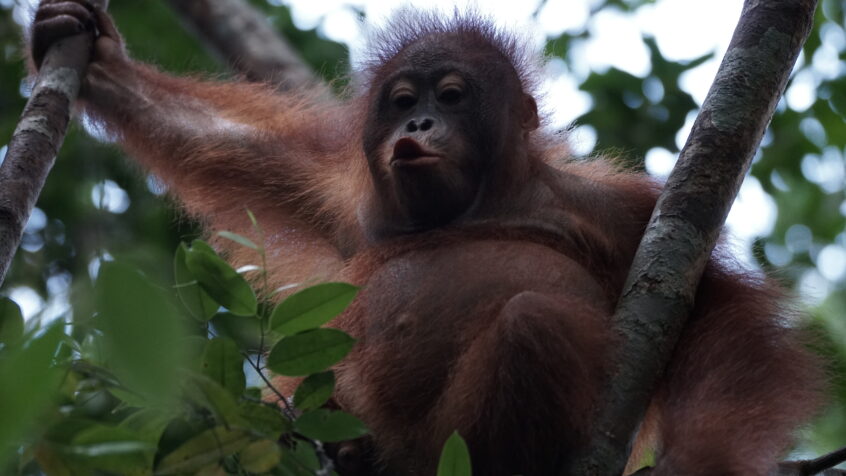

Redi
Over the past month, Redi and his group have completed two forest school sessions. For the past several months, this group has begun staying overnight directly in the forest during their school periods. Based on observations by the SOC team, Redi is now able to build his own nest—an important milestone that reflects significant progress in his survival skills and readiness for the next stage of rehabilitation.
Interestingly, despite being capable of building his own nest, Redi was once observed taking over a nest built by Seko, another individual in his group. Given Redi’s more dominant personality and Seko’s comparatively timid nature, Seko quickly vacated the nest when Redi approached. This interaction reflects natural social dynamics that contribute to behavioral learning, including understanding spatial boundaries, social hierarchy, and responses to social pressure within a semi-wild environment.
During forest school sessions, Redi and his group are provided supplemental food only twice a day—once in the morning and once in the afternoon. This feeding schedule is designed to encourage their ability to independently search for and identify natural food sources. While supplemental feeding ensures that their daily nutritional needs are met, it also promotes exploration and strengthens their foraging skills within their natural habitat.
At the same time, feeding frequency is carefully managed with consideration for the ecological carrying capacity of the Jerora Forest School area. The availability of natural food sources and the need for vegetation regeneration are important factors in ensuring that the rehabilitation process remains sustainable without placing excessive pressure on the forest ecosystem that serves as their learning environment.
Outside of forest school sessions, Redi’s activities in the overnight cage remain stable and active. To support both his welfare and learning process, he receives various forms of enrichment, including structural and food-based enrichment.
Structural enrichment in his cage includes hammocks and tires suspended with ropes, providing opportunities for climbing, swinging, and practicing balance. Food enrichment is presented in varied and stimulating forms, such as leaf parcels filled with peanut butter, sunflower seeds inserted into banana tree trunks, ice blocks containing red beans, and other creative variations.
These enrichment activities not only enhance Redi’s overall well-being but also play an essential role in his rehabilitation process at Jerora Forest School. Through these simple yet meaningful challenges, Redi is encouraged to explore his surroundings, develop his cognitive abilities, and reinforce natural behaviors such as problem-solving and active foraging. This approach helps ensure that his daily activities provide ongoing physical and mental stimulation, supporting his gradual development toward greater independence.

Redi