30-04-2026
|
BANIR
The extreme weather this month has, to some extent, affected Banir’s daily routine. Under the intense midday heat, she has been seen approaching water sources more frequently to drink. At times, Banir even “steals a moment” to play with water—splashing her face and body as if taking a bath, seemingly trying to cool herself down. Nevertheless, her overall health condition remains good and stable.
Changes have also occurred in her social dynamics. Previously, Banir spent much of her time with Julia in the night cage. Now, she is spending her days in a different group. A regrouping process has been carried out, separating the original group of five individuals. Banir now shares space with Redi and Manfred in the adjacent cage. Although both are known to be quite dominant, Banir has adapted well. Their interactions so far have been safe and relatively stable, indicating that Banir’s social skills are becoming more mature as she adjusts to her new environment.
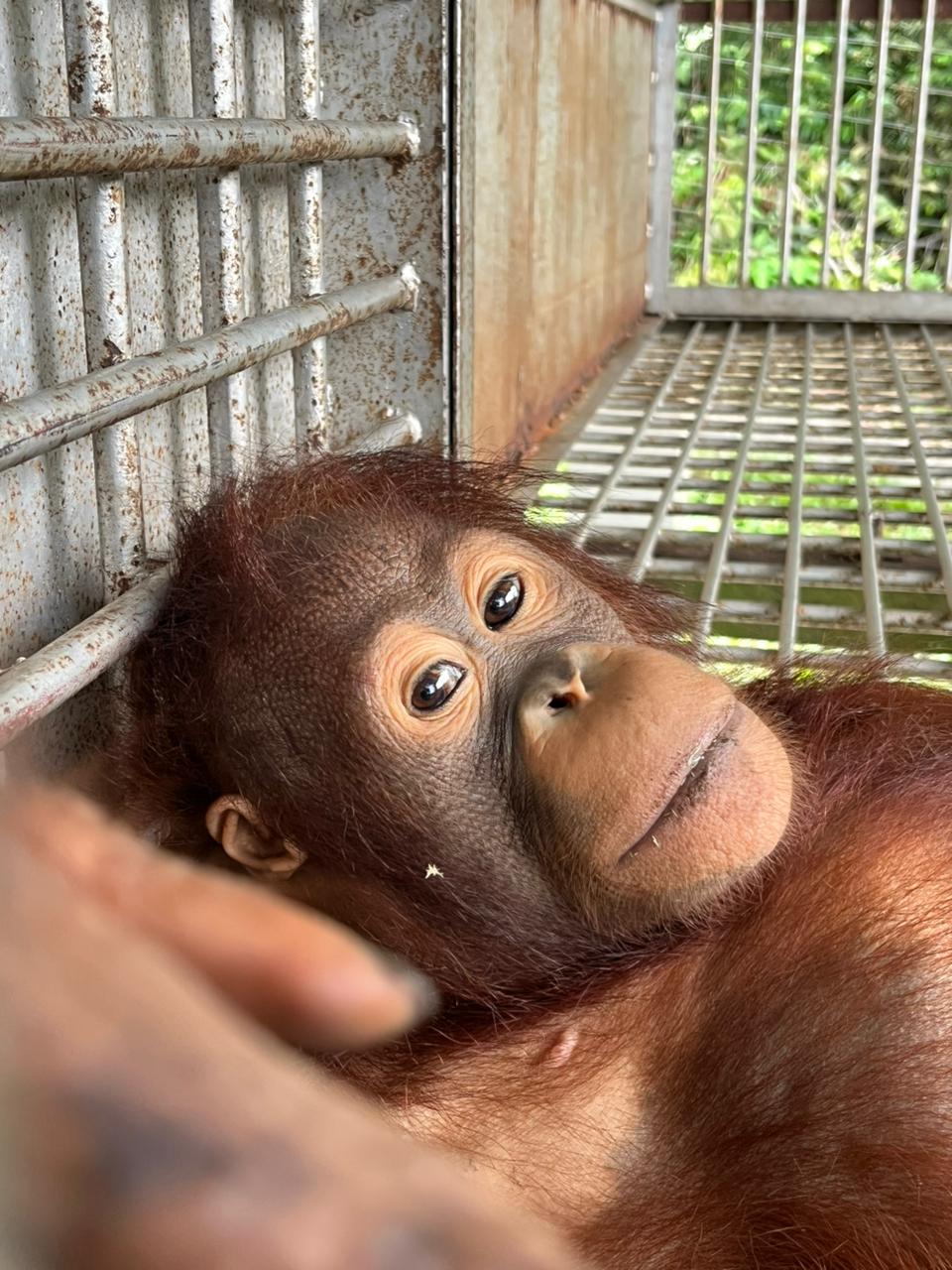
Compared to Manfred, who tends to be very active—constantly moving, shifting from one spot to another, and swinging in the hammock—Banir shows a much calmer character. Outside of feeding times, she is often seen relaxing, even resembling a “couch potato” in her cage. She can lie on her stomach on the floor with her legs stretched out wide for quite a long time, wearing a relaxed expression. Only her eyes remain busy, observing the activities of other orangutans at forest school. At other times, she sits leaning against the corner of the cage, quietly enjoying the surroundings in her own way.
Despite her calm demeanor, Banir also has an unexpected side. Occasionally, without warning, she suddenly hangs in unique positions along the metal panels—areas that are rarely used by Redi or Manfred. These moments become small surprises, revealing that beneath her calm nature, Banir still possesses curiosity and a drive to explore.
In the morning or late afternoon, when the temperature becomes more comfortable and the tunnel access is opened, Banir takes the opportunity to explore the lower area. She appears selective in choosing the wild plants growing around her—picking reachable leaves and tasting them with curiosity. This simple activity is an important part of her learning process in recognizing her environment and identifying natural food sources.
Banir’s forest school activities have also progressed well this month. During the two sessions she attended, she was seen actively exploring the area and foraging independently. She consistently made use of various available natural food sources, tasting them one by one with enthusiasm.
As usual, her feeding activity leaves a distinctive “mark”—Banir’s lips often change color after consuming different forest plants. This unique trait not only serves as a small signature of her individuality but also indicates that she is becoming more actively engaged in learning to recognize natural food sources.
Through these seemingly simple daily moments, Banir continues to demonstrate positive adaptation—toward environmental changes, social dynamics, and natural conditions. Every behavior she shows is part of a long journey toward independence, bringing her step by step closer to life in the wild.